Your business may appear prominently on Google Maps today, but that does not mean it will maintain the same position next month. Local search results change as competitors update their profiles, new businesses enter the market, and Google evaluates different ranking signals.
For local businesses, checking rankings once is not enough to understand long-term visibility.
Regular monitoring helps identify whether a business is becoming more visible, losing positions, or maintaining consistent rankings across its target locations.
A Google My Business Ranking Checker makes this process easier by showing where a business appears for relevant searches.
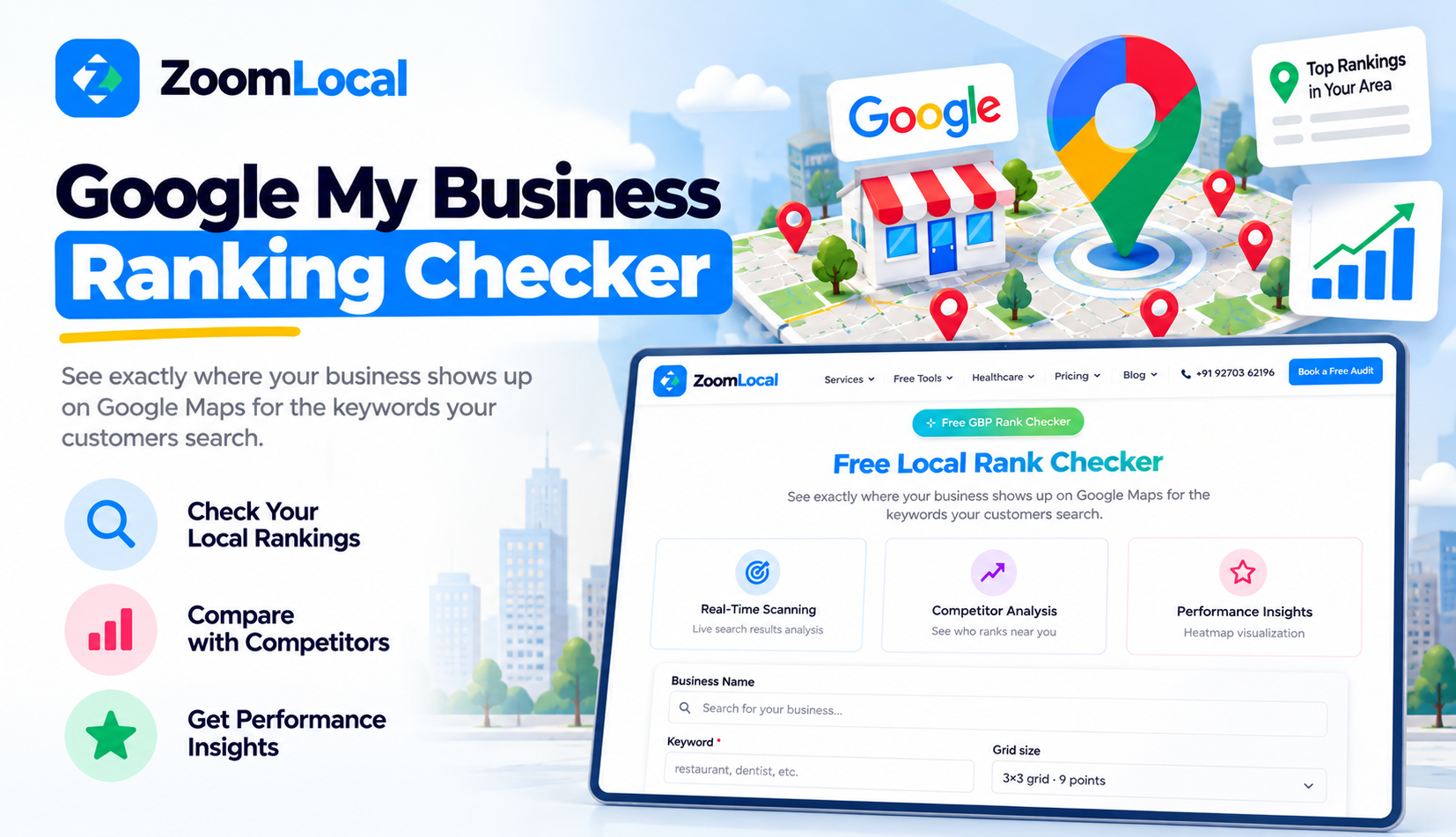
Using the Free Google My Business Ranking Checker by ZoomLocal businesses and digital marketing agencies can examine geographic ranking patterns and develop a more organized monitoring process.
What Does Monitoring Local Rankings Mean?
Local ranking monitoring involves checking a business's Google Maps positions at different times and comparing the results.
Unlike a one-time ranking check, monitoring focuses on changes.
For example, a dental clinic may rank third for "dental clinic" in one neighbourhood during its first check.
A month later, the same search may place it fifth.
Recording both results helps the clinic recognize a change worth investigating.
However, a ranking movement alone does not explain why the change happened.
Monitoring provides evidence of visibility changes, while further analysis helps identify possible causes.
Start With a Baseline Ranking Report
Before making SEO improvements, establish your current ranking positions.
This initial report becomes the baseline for future comparisons.
Choose your business profile, select an important service keyword, and examine the geographic area where you want to attract customers.
Record the results and the date of the check.
For example, a restaurant might begin by examining its visibility for "family restaurant" across nearby neighbourhoods.
When the next report is prepared, the original results provide a reference for understanding what has changed.
Without a baseline, it becomes difficult to evaluate progress accurately.
Choose Keywords That Reflect Your Business Goals
Monitoring every possible keyword is unnecessary.
Instead, select search terms that represent your most important services.
A physiotherapy clinic might monitor "physiotherapy clinic," "sports injury physiotherapy," and other genuinely relevant searches.
A restaurant may focus on cuisine-related or dining-related terms.
Avoid relying only on searches containing your business name.
Branded searches show whether customers can find a business they already know, while non-branded service searches provide a different view of local discovery.
Keeping a consistent keyword list also makes comparisons easier.
Monitor Rankings Across Different Geographic Points
Google Maps rankings depend partly on the searcher's location.
A business may appear among the top three results close to its premises but rank lower several kilometres away.
This makes geographic monitoring particularly useful.
ZoomLocal's ranking checker uses a grid to examine Google Maps positions from multiple search locations.
Each grid point represents a different geographic area.
By reviewing the grid, businesses can identify where their visibility is strong and where their positions are lower.
For meaningful monitoring, compare the same geographic points whenever possible.
Understand Changes in the Ranking Grid
A colour-coded ranking grid helps users recognize geographic visibility patterns.
For example, a diagnostic centre may initially have strong rankings around its location and weaker positions in surrounding neighbourhoods.
During a later check, some of those weaker positions may improve.
This can indicate a change in local search visibility.
However, the improvement should not automatically be attributed to a particular SEO activity.
Search results can fluctuate because of competition, distance, and other factors.
Comparing multiple reports provides more useful context than reacting to one movement.
Decide How Often to Check Rankings
The appropriate monitoring frequency depends on the business and its competitive environment.
A business operating in a highly competitive area may benefit from weekly or fortnightly checks.
Another business may find monthly monitoring sufficient.
The important consideration is consistency.
Checking rankings several times in one day may create unnecessary confusion because results can fluctuate.
Establish a practical schedule and use similar conditions for each check.
This helps businesses identify meaningful patterns rather than temporary changes.
Monitor Competitors Alongside Your Business
Local ranking changes become more informative when you examine the competitive environment.
Suppose a salon previously appeared in the top three results for an important keyword but now ranks lower.
A competitor may have moved into a more prominent position.
ZoomLocal's ranking checker provides competitor visibility information for local 3-pack results.
This can help businesses identify which competitors appear prominently in relevant areas.
Further research can then examine their services, reviews, categories, and websites.
Competitor information supports analysis, but it does not reveal Google's exact ranking calculations.
Record Important SEO Changes
Ranking reports become more useful when businesses maintain a record of significant updates.
For example, note when you change a business category, update website service pages, correct profile information, or add relevant business photos.
Keep these dates alongside your ranking reports.
If rankings change afterward, the timeline may help identify developments worth investigating.
However, timing alone does not establish cause and effect.
Google Maps positions are influenced by multiple factors, so avoid assuming that every movement resulted from a specific update.
Create Monthly Reports for Clients
Digital marketing agencies can use ranking monitoring to provide clients with clearer performance updates.
Instead of reporting only one keyword position, agencies can explain how visibility differs across important neighbourhoods.
ZoomLocal supports shareable and white-label ranking reports, making it useful for presenting geographic search findings.
An agency report can include the selected keyword, geographic area, ranking observations, and recommended next steps.
This approach helps clients understand what the data shows.
It also creates a record that can be compared during future reporting periods.
Use Ranking Trends to Guide Optimization
Monitoring becomes valuable when findings lead to practical decisions.
If a business consistently ranks poorly for a relevant service keyword, review whether its profile and website accurately explain that service.
If rankings are weaker farther from the premises, consider whether distance and nearby competition are influencing the results.
Avoid responding to every ranking decline by adding more keywords to the business description.
Google considers relevance, distance, and prominence when determining local rankings.
Optimization decisions should reflect genuine business information and realistic geographic opportunities.
Look Beyond Rankings When Measuring Results
Higher Google Maps positions may create more opportunities for discovery, but rankings do not guarantee customer enquiries.
Businesses should also review website visits, calls, direction requests, and other available performance information.
For example, a clinic may experience relatively stable rankings while receiving more enquiries.
Another business may improve its ranking positions without seeing an immediate increase in customer activity.
These differences show why ranking data should be considered alongside business outcomes.
A complete local SEO review examines both visibility and customer engagement.
Make Local Ranking Monitoring a Regular Process
Monitoring local rankings helps businesses understand how their Google Maps visibility changes over time.
A Google My Business Ranking Checker provides the information needed to compare positions, identify geographic differences, and observe competitor activity.
ZoomLocal's geographic ranking grid and reporting features can support this process for individual businesses and digital marketing agencies.
The most effective approach is to establish a baseline, select relevant keywords, check rankings consistently, and investigate meaningful changes.
Start monitoring your Google Maps visibility with the ZoomLocal Local Rank Checker and use the findings to make better-informed local SEO decisions.
Comments